Mostrando entradas con la etiqueta research. Mostrar todas las entradas

domingo, 26 de junio de 2016

euroCRIS 2016 conference in St. Andrews, Scotland


From 9th to 11th of June I attended and participated in the euroCRIS conference held in St. Andrews, Scotland, a beautiful town where the St. Andrews University is located.


The title of the conference was: CRIS2016: Communicating and measuring research responsibly: profiling, metrics, impact, interoperability.

You can access the program with the links and proceedings of the presentations, here.

There were a lot of interesting presentations. I found really interesting the keynote presentation of Barend Mons.

I also presented my paper talking about ‘Can machines understand what researcher look for? Conceptualizing the research world.’ (you can access the paper in the previous program link)

In summary, I heard very interesting projects all related to two main themes:

  • Can we have more and better research indicators and metrics, taking into account the new digital research scenario? Yes, and we need it.  
  • Can we order the amount of information that are in the Internet to help researchers in their work? Yes, and it is longer necessary,

     In this way, we can talk about projects like: snowball metrics, Dspace/CRIS openSource, InCites, SELRIM project, Thor project and so on. And also projects about semantic searches solutions, like the one that we are starting in SIGMAAIE, that I presented.

Photos of my presentation:


Other presentations photos:


In my opinion, euroCRIS is a good space to interchange initiatives and projects related to research but I think that, in general, the cooperation should be higher in this kind of forums, anyway it was interesting, and now a have a lot of ideas and new interesting and valuable contacts!.


martes, 31 de mayo de 2016

Report on EUNIS – euroCRIS joint survey on CRIS and IR


Recently it has been published the final report of the CRIS/IR survey. That was a joint initiative of EUNIS and euroCRIS.

The goal of this survey was to collect information on CRIS (Current Research Information Systems) and IR (Open Access institutional repositories) technological solutions that support Research, and to analyses their links to other systems used at Higher Education Institutions.

The authors of the final report are:

Lígia Maria Ribeiro has been Principal Researcher at the Faculty of Engineering of the University of Porto since 2002. She was pro-rector at the University of Porto between 2006 and 2014, being responsible for ICT. Between 2004 and 2006, she was President of EUNIS, after being Vice-President for two years. She is presently a member of the EUNIS Board of Directors. 

Michele Mennielli is responsible for International Relations and Business Development at Cineca, the Italian Consortium of University. He cooperates with different international organizations to create cross-national collaborations and projects. He is Board Member and Secretary of EUNIS; Member of the DSpace Steering Group and Board Member Executive for External Relations of euroCRIS. 

Pablo de Castro works as Open Access Project Officer at LIBER, the Association of European Research Libraries in The Hague. He is an expert in Open Access and research information workflows and management systems, an area he›s worked at for GrandIR Ltd and the EDINA National Data Centre in Edinburgh. MSc/BSc in Physics from UCM, he has a background as Institutional Repository manager for the Spanish National Research Council (CSIC). Besides being an ORCID Ambassador, Pablo is also serving on the euroCRIS Board as leader of the CRIS/IR Interoperability Task Group.

I know in person the three autors and I can say that they are great professionals with a great reputation in the research scope.

The CRIS/IR survey was launched in April 2015 and was based on a previous initiative to collect information on the CRIS and IR infrastructure available in Portugal.

The goal of the survey was want to know about:

- How these two systems interoperate?
- Which data and metadata are made available and how these are being used?

The survey was distributed via mailing lists to the scientific community and institutions. 

There was wide participation from the community, there was 84 full responses from 20 different countries.


The two main questions the Survey tried to answer were: are CRISs gradually replacing IRs? Are the two systems overlapping in their functionalities? From the results we have collected, both questions seem to get a negative answer. The two systems are clearly complementary: while IRs are the preferred choice for managing research publications and dissertations and thesis, CRISs are regularly chosen for managing the institutional research information as a whole including metadata for research papers.

Some conclusions are:

About the use:
  • 62% of the institutions have both systems: CRIS and IR
  • 18% uses the same software
Aboout their contents:
  • CRIS systems hold a large variety of contents: metadata for research publications (81%), projects (76%), and reporting features (75%)
  • IR stores mainly metadata and full-text for publication (96%), dissertations and thesis (86%).
  • DSPACE is the most used software for IR (56%) 
About the interoperability:
  • Almost 65% of the institutions have linked their CRIS&IR (so, there are closely related)
  • CRIS is also the product which links with legacy systems, such finances or HR
  • There are little integration between LMS (Learning management systems) and CRIS o IR.
Another important aspect the survey collected information on was the management of CRISs systems. This will usually vary from one institution to the next, but the conclusion is that Libraries and the Research & Innovation or Research & Development units have a prominent role on the different aspects of CRIS management.

As a key conclusion, both CRISs and IRs are considered valuable tools to support Institutions in the research assessment exercises for both university and author evaluation.

You can access to the final report here.

lunes, 30 de mayo de 2016

What about research assessment systems?

Research assessment systems are a very important and complex issue in the research scope, in this way, I found an interesting matrix that, in my opinion, defines very well, at a high level, what research is, and what it can or must be evaluated:


In this matrix of assessment, we can clearly distinguish the main research topics, so we can see:

The research main actors like the researcher, the research group, the department, the institution, or the research fields. Based on this, we can make a series of questions related to the assessment:  the purpose is it to inform the allocation of research funding, to improve performance, or to increase regional engagement?

Then there are questions about which output dimensions should be considered: scholarly impact, innovation and social benefit, or sustainability? 

In this way, describes four assessment methodologies: peer review, which provides a judgment based on expert knowledge; end-user reviews, such as customer satisfaction; quantitative indicators, including bibliometric and other types of measures; self-evaluation.
These four methodologies can be — and often are — combined into a multi-dimensional assessment.

Bibliometric indicators have a central role in research assessment systems, and the main types are: basic indicators (easy to obtain and available for decades), normalized indicators (correcting for particular biases) and advanced indicators (based on advanced networks analyses)

You can see all this information in this article. This article if from 2011, so it’s not new, but I think that the concepts that appeared in the matrix, are key concepts and a good summary of what research scope is. Do you agree? 

viernes, 4 de diciembre de 2015

Science Business Annual Summit (ESADE FORUM)


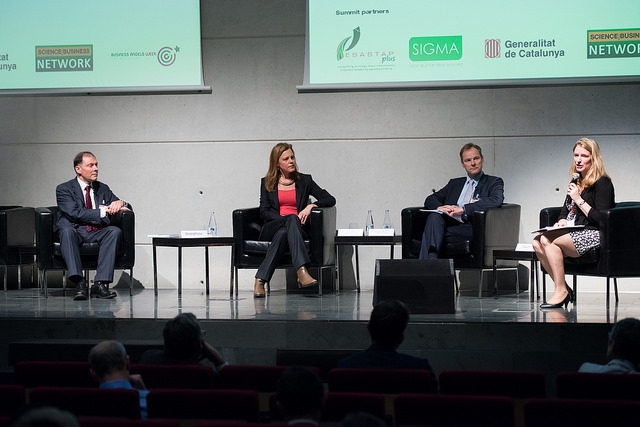
Past November 20, I attend and participate the 2015 Science Business Annual Summit held in ESADE FORUM in Barcelona. The conference was about how through science and innovation, the economic growth and sustainability could be improved.

There were a lot of really interesting contributions, talking about innovation, research, bigData, IoT, Climate Change and the main issues related with the European growth.
  
I introduced and moderated the ‘15-minutes inspiring talks’, and I had the opportunity to talk about the value of the Open Research and the Open Innovation as a key issues in this globalized and digital world, where immediacy is so relevant. In this way, I spoke about how, nowadays, the researcher is more than ever in the spotlight.


As a summary, I  write a compilation of highlights from the summit:

- Big Data and forecasting are big challenges.
- Science is for society and science is with society.
- The importance of data-driven innovation.
- The importance of recruiting the best scientist and researchers.
- The importance of enhance collaboration.
- The diversity of people in a city, promotes innovation.
- In 20 years, most cars will be self-driven.
- The impact of internet of things is extremely underestimated.
- If you want to growth a business, innovation is necessary.
- Collaboration between university students and companies and between researchers and companies, a key issue.


In short, an interesting event, where you understand that the innovation is necessary but it's necessary to enhance it, and also the research, to make more and better research… all of this, helped me to strengthen my ideas!

Here you could see a video with the highlights from the conference:


And... finally, one of the sponsors of the event, was SIGMA AIE !


martes, 1 de diciembre de 2015

Open Research Glossary

           
Increasingly, there are more and more resources talking about Open Research or Open Science. The Right to Research Coalition is a good example. 

They talk about mainly Open Access, and say that unfortunately, not everyone has access to the scholarly literature, despite advances in communications technology.  The high cost of academic journals restricts access to knowledge. Despite these high prices, authors of scholarly articles are not paid for their work. 

The profits from these publications go solely to the publishers of the journals. A vast amount of research is funded from public sources - yet taxpayers are locked out by the cost of access.

Also thay state that, at the same time, digital technologies have opened new opportunities for research. New tools facilitate faster discoveries, speed the development of new technologies, and accelerate the progress of science. Patients could have access to the latest medical research, citizens could evaluate scientific information on environmental impacts, and developing countries could apply the most recent scholarship to public health and development efforts. But access barriers leave these opportunities under-explored. 
Open Access has achieved remarkable success to date: more than 4,000 open-access journals are published today; millions of articles are made available via open-access repositories; and dozens of policies from universities and research funders support Open Access; but still more needs to be done. 
So, the undersigned of this coalition of student organizations endorse Open Access as the preferred model for scholarly communication, and they say that its because:
(a)    Open Access improves the educational experience. All students, regardless of their institution’s ability to afford subscriptions, should have access to the full scholarly record, whether for assigned reading, research for a term paper, or literature review for a dissertation.
(b)    Open Access democratizes access to research.  Students from around the world should have full access to the scholarly literature, along with patients looking for medical information and citizens seeking to learn about the environment or other scientific topics.
(c)    Open Access advances research.  Open Access helps researchers be more productive by facilitating access to the latest studies. Open Access also enables new techniques for computer-assisted research, paving the way for scientific advancements.
(d)    Open Access improves the visibility and impact of scholarship. Today's student is tomorrow’s scholar. Recent studies suggest that Open Access articles are downloaded and cited more frequently than articles that are accessible only through subscription. Open Access fulfills researchers’ professional responsibility to maximize the impact of their research.
So they publish a really interesting Open research glossary that you can access here, hope enjoy it!

sábado, 28 de noviembre de 2015

euroCRIS membership meeting


Past 10 november 2015 I was participated in the euroCRIS membership meeting in Barcelona. It was a really interesting meeting. There, I made a speech called: Research information systems: what’s new?

In my presentation, I talked about that nowadays there is a new scenario, a new paradigm about research, where all is open, and I asked, how did we get here? I talked about that traditionally, to make public a new discovery, could take a lot of time, from 6 months to 1 year or more. And that this is a valid but also an expensive system for several years and that actually, there is a different scenario where immediacy is more relevant. 

Also talked about this globalized world, where new forms of doing research have appeared. That researchers must take into account new forms of doing their research. And that this is the so-called Open Science or Open Research, putting, more than ever, the Researcher in the spotlight.


In this way I explain that new practices such as: Open Source, Open Access, Open Data, Open Notebook, Open Peer Review, have appeared, and with international collaboration and new ways to measure the research (Altmetrics), shape this new scenario, in order to new knowledge flow better and faster.
I highlighted that Open Science it’s not necessarily a substitute of the traditional methods of doing and evaluating the research, but it’s a new and added way of do it.
Finally I explained that, at SIGMA, through our suite SIGMA RESEARCH, we are working hard to provide the best tools and functionalities to support this new scenario, providing not only software, but also values like: experience, proximity, service, innovation, social responsibility and so on.
During the meeting there was really interesting speeches and round tables talking about some of the European initiatives for the research information management. Some of them focused on the ORCID (unique author identifier), and the CASRAI (dictionary of standardized research terms) evolution, and about relevant initiatives like OpenAIRE2020 to enhance the OpenAccess movement. Other projects like THOR (Technical & human infrastructures for open research) where explained, as well as all kind of identifiers (like ORCID) related to the research like ISNI, Ringgold, and so on. We saw details about the status of CERIF and CERIF API specification, and the major understanding of the growing importance about the use of this model in the CRISs and other applications. Another projects or initiatives like: SELRIM, DRIS, COAR, CODATA, EARMA and so on was also discussed. 


domingo, 2 de agosto de 2015

Correlación entre Citaciones y otras métricas

Varias veces he leído que no hay una fuerte correlación entre las métricas que llamamos Altmetrics, con el impacto en el número de citaciones que posteriormente pueda tener ese artículo. Así, un artículo que sea accedido muchas veces puede no tener muchas citaciones, realmente.

He leído un interesante estudio liderado por el profesor Xianwen Wang de la Dalian University of Technology de China, que ahonda un poco más en estas afirmaciones.


Han analizado sobretodo el diferente impacto que tiene un artículo cuando éste es accedido vía HTML o bien descargado en PDF y analiza el camino que va desde la atención que despierta un artículo y su materialización en forma de citación del mismo.

Básicamente destaca que, cuando un artículo se descarga en PDF, es más fácil que éste sea citado, respecto a si es accedido en formato WEB (HTML).

Así lo que se preguntan es: ¿Altmetric tiene efecto en las citaciones?

La conclusión es que la correlación entre Altmetric y vistas del artículo en HTML es alto y en cambio es más bajo entre Altmetric y descargas en PDF.


Respecto a la atención social que despierta un artículo (que se puede ver en el gráfico), la conclusión es que es más probable que un artículo en HTML sea leído que si es descargado en PDF. Aún así, la atención social incrementa la posibilidad de descarga (que ya hemos visto que hace que pueda aumentar la probabilidad de citación).

Así pues, lo interesante realmente es que un artículo tenga interés social y que consiga ser descargado en PDF para aumentar las posibilidades de citación y, por ende, su impacto.

Es interesante ver cómo está evolucionando el escenario de la reputación e impacto de la investigación en este mundo digital que nos ha tocado vivir. ¿estáis de acuerdo con este estudio? ¿os parece que es así?

Podéis consultar el estudio aquí.

sábado, 20 de junio de 2015

Reputation mechanisms in Science 2.0

I have read a lot about reputation in science, this is not a new topic. Traditional scientific reputation is about cites and impact of publications in major scientific journals, but if we think about what we call Science 2.0, digital science or open science, maybe could be something new. How we can measure scientific reputation in this new digital scenario? 

First of all, I think that it's time to rethink, time to change and it's clear that science is changing, at least the way we do science, or the perception of the science, and this is mainly because of the new technologies. New digital technologies make available to researchers powerful tools that allow them support their tasks, foster collaborations, promote dissemination and enhance the reputation of the researchers..

But, and always is a ‘but’, I think there are actually too many tools and there is not yet a clear or unique strategy to promote this new way of scientific reputation, in my opinion.

I have read a very interesting report: JRC science and policy repot, that talk about:

Emerging reputation mechanisms for scholars. This report has confirmed my impression that there are too many tools actually.


Anyway, is a very interesting report explaining that conventional indicators fall short of reflecting adequately contributors' reputation and impact in the field of stablishing and measuring scholarly reputation. Also emphasizes the importance of science and talk about Science 2.0 that is chanching the conventional ways of the collaboration of the general public in the creation, dissemination and transferring of the knowledge.

The report also introduces the Boyer's model of scholarship adapted to the digital age:

- The scholarship of research, creation of the knowledge
- The scholarship of integration, interdisciplinary research
- The scholarship of application, research transfer to solve societal/practical problems
- The scholarship of teaching, transfer knowledge to new generations
- The scholarship of co-creation, involve other actors in the research process

In each of these activities, reputation plays a very important role. In the scholarship of research is clear that a researcher need acquire ideas from other scholars, evaluates the validity of ideas for further exploration and for subsequent research, and in turn to disseminate the results to the scientific community. In this way, the nature of research work commands the need for recognition of the value of one’s work by others in the field.

Reputation is not only the result of the research process, also is the result of its three main outcomes: some kind of publication (journal article, book, report…), the impact on others’ research or knowledge, on industry, in society or the way we think about ourselves as a human beings, and the enhancing of the reputation of the researcher (invitations, awards and promotion, and to obtain further funding). But how this is archived? Weller (2011) talks about:

Planning (using social networks and blogs, the researcher establish the question), Collect data (online information sources), analyses (using Google analytics, SurveyMonkey, data visualization…) and reflect (blog posts and video interviews). 

Then there is the dissemination of research results, and not only through books and journals but also essays, blogs, podcasts, videoclips... will also be seen as perfectly viable means for disseminating ideas. 

By now, apart from publishing their research data, a small but growing number of scientists even practice Open-Notebook Science (ONS), where researchers post their laboratory  notebooks on the internet for public scrutiny. Another way is the networking and collaborating (if the researcher collaborate with similar colleagues, can obtain a great number of cites)… Anyway , although there are other forms of peer review and citation analysis and impact through new digital tools and services, it is clear that the researcher remains evaluated by traditional metrics, but this will be change...

The scholarship of integration seeks to critically analyze, interpret, draw together and bring new insight to bear on original research, so this integrative mode of research, combines perspectives, information, data, techniques, tools, concepts and/or theories that usually cannot be solved by a single disciplinary approach, so it is important to interact with and learning from people with different backgrounds. The traditional academic career incentives do no stimulate interdisciplinary research, so this is one king of research where new science 2.0 can help more. 

The scholarship of application want to link theory and practice through dynamic interaction with various stakeholders. So want to communicate the knowledge to others, and has four types: knowledge exchange among scientists, knowledge exchange from scientists to public, knowledge exchanged iteratively from scientists to non-scientific public and vice-versa and knowledge exchange between scientific knowledge and local knowledge where are mutual respected. In this model, citizens work actively with science knowledge: asking questions, with research agendas, through consultations, and so on…

In the scholarly of teaching, there is a new model where research and teaching are both viewed as ctivities where individuals and groups negotiate meanings, building knowledge within a social context. And finally in the scholarship of co-creation, through Science 2.0, produces the discovery of new knowledge and the processes of participatory learning intertwine at time to form a whole.

There are many tools that can measure the reputation that a researcher can acquire through its researcher works, in this way there are: altmetric services, citizen science platforms, code repositories,data repositories, discipline-specific academic social networking services, electronic laboratory notebooks, multidisciplinary academic social networking services, open peer review systems, professional  social networking services, reference management tools with social media feature, review systems for MOOCs, social learning platforms.

In this way, ResearchGate and Academia support the reputational purposes of the larger number of activities. But we can see, tweeter, Facebook, LinkedIn, Mendeley and other tools…

In summary, and is my summary, with traditional model of reputation, a researcher can be well valued mainly for their peers and colleagues. With Science 2.0, a researcher can (and must) create its digital identity and can be recognized not only by a major number of interdisciplinary colleagues, but also by the society, and in the case of peer review, if a researcher perform an interdisciplinary research, the peer-review tasks in the traditional way could be more complex, but not in science 2.0. This report talks about the importance of the research openness and I agree. It’s time to use the internet potential to increase the visibility of the research and its results: collaborate, share, network, disseminate, teach…..

What do you think about scientific 2.0 reputation? contributions? experiences?

Access JRC report here

domingo, 17 de mayo de 2015

‘Evolving manuscripts’: the future of scientific communication?


I just have read a very interesting post in THE (Times Higher Education) about 'Evolving manuscripts' a new concept that could be the future of scientific comunication, where scientists may communicate their results through “evolving manuscripts” a kind of paper that are updated continually over a working life.


In this way, a researcher may have only two or three publications throughout his career, Thus , a publication can have multiple versions as as the area of research develops.


This idea was exposed by Sir Mark at the second part of the Royal Society’s 'Future of Scholarly Scientific Communication conference', held in London on 5-6 May.


His idea would help to mitigate “perverse incentives” in the current system, he said. These include a bias against publishing negative results or those that confirm or confound existing research, as well as the pressures that scientists face to split a piece of work into multiple articles.


An “evolving manuscript” would begin with a pre-publication, pre-peer review “beta 0.9” version of an article, followed by the approved published article itself, which Sir Mark dubs “version 1.0”.


I think it is a simple yet revolutionary concept that can change once the academic and research scenario and make it better suited to the stage that we face in this century full of new challenges.

You can read full post (with a very striking photo)  here. :-)


lunes, 3 de marzo de 2014

La evolución del OpenAccess con OpenAIREplus


Como sabemos, OpenAIRE, que se inició a finales de 2009 dentro del FP7, es la infraestructura OpenAccess europea que recolecta e integra información entre diferentes fuentes CRIS individuales. Se ha ido consolidando a lo largo de estos años.

Así pues, OpenAIRE es una red de repositorios y agrega contenido de un amplio rango de fuentes de datos, sobretodo literatura y repositorios de datos así como de editores. OpenAIRE utiliza datos del directorio de repositorios Open Access, OpenDOAR. 


Algunos ejemplos de repositorios institucionales que son OpenAIRE compliant, son:


Todos estos repositorios, se pueden encontrar a través de OpenDOAR, ROAR, Datbib o Re3datos.org

Actualmente da acceso a más de 8.094.461 publicaciones y 611 datasets de 461 repositorios y ediciones en acceso abierto.

Para enriquecer este contenido aún más, OpenAIRE planea ir añadiendo contenido de investigación procedentes de los diferentes CRISs. Para ello, OpenAIRE plus (2a generación de Infraestructura Open Access para investigación en Europa), que se inició a finales de 2011, es la nueva iniciativa que da continuidad al proyecto OpenAIRE todavía dentro del FP7, con la incorporación de colecciones de datos de investigación (datasets) conjuntamente con los artículos científicos resultantes. Esta iniciativa, que está en fase beta, tiene un enfoque multidisciplinar a causa de la heterogeneidad de datos y las diferentes comunidades que lo forman. 

En resumen, el depósito y acceso a publicaciones vinculadas a través del portal OpenAIRE estarán apoyados por un Help Desk, y la estructura de redes colaborativa de OpenAIRE se extenderá para promover las publicaciones abiertas mejoradas entre comunidades de usuarios. Las oficinas de enlace de cada uno de los 31 países europeos del proyecto trabajan para apoyar las necesidades de los investigadores en Europa. El proyecto aprovechará las conexiones internacionales para contribuir a la creación de estándares comunes, tipos de datos e interoperabilidad a nivel global.

Por último, para aquellos investigadores que no puedan publicar en ningún repositorio institucional OpenAIRE compliant, tienen la opción de ZENODO. Es un repositorio institucional de publicaciones llamadas “huérfanas”. Pertenece al CERN y permite depositar el artículo y/o datos de investigación en OpenAIRE, ayudando así a los investigadores a cumplir con la demanda de la EC y de ERCs acerca de OpenAccess. OpenAIRE implementa el protocolo OAI-PMH para acceso.


Links: