Mostrando entradas con la etiqueta science. Mostrar todas las entradas

sábado, 13 de febrero de 2016

The way to Open Science

Science is broadly understood as collecting, analyzing, publishing, reanalyzing, critiquing, and reusing data. Proponents of open science identify a number of barriers that impede or dissuade the broad dissemination of scientific data. 

These include financial paywalls of for-profit research publishers, restrictions on usage applied by publishers of data, poor formatting of data or use of proprietary software that makes it difficult to re-purpose, and cultural reluctance to publish data for fears of losing control of how the information is used.

One of the main goals of the Open Science movement is the open Access of the research publications and data. In this way, the European University Association (EUA) agreed at its Council meeting on 23 October 2015 on the development of a roadmap to assist European universities in the transition to Open Access (OA). This initiative follows on from a recommendation made by EUA’s Expert Group on Science 2.0/Open Science.

They defined a roadmap that focuses primarily on OA to research publications, as in the broader field of Open Science most progress has been accomplished in this area. It is intended as the first step in a series of initiatives that EUA and its Expert Group are developing to address the most pressing implications of Open Science, including, inter alia, OA to research data, copyright, data protection and text and data mining; new models of evaluation and quality assessment; digital literacy and awareness.

The main objectives of EUA strives to achieve this vision in the next three years by concentrating on the following areas:

· Fostering structured dialogue among all stakeholders – especially scientists, universities, research funding and performing organisations, libraries, politicians and publishers;
· Promoting and supporting the adoption of OA policies, infrastructures and initiatives (repositories, institutional publishing initiatives – both for journals and monographs) by European universities;
· Encouraging the development and establishment of advanced scientific recognition and research assessment systems – including scientometrics and altmetrics, quality evaluation in OA, career progression of scientists and rigorous quality assurance of conventional and novel research outputs;
· Addressing intellectual property rights and copyright policies for various outputs, including publications, research data, learning materials and patents; · Considering alternative and sustainable OA business models;
· Promoting access, use and sharing of research publications and data, including text and data mining (TDM), tailored to different stakeholders, including researchers at different stages in their career;
· Encouraging, supporting and eventually monitoring the establishment of comprehensive standards for institutional OA policies concerning research publications and teaching materials. Priority actions EUA will focus its efforts in the next twelve months

I think it's a very interesting initiative, and necessarily. Nowadays, OpenAccess is a reality that we must take into account, but there are already some issues to make it totally possible, related to the quality of research, paywalls, peer review and so on, but no one denies that Open Access and thus, open Science are the new research models in this digital and globalized world.

Can see more information about the initiative here:


viernes, 4 de diciembre de 2015

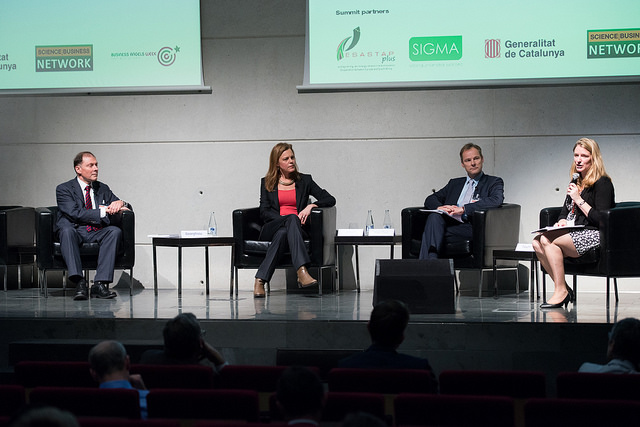
Science Business Annual Summit (ESADE FORUM)


Past November 20, I attend and participate the 2015 Science Business Annual Summit held in ESADE FORUM in Barcelona. The conference was about how through science and innovation, the economic growth and sustainability could be improved.

There were a lot of really interesting contributions, talking about innovation, research, bigData, IoT, Climate Change and the main issues related with the European growth.
  
I introduced and moderated the ‘15-minutes inspiring talks’, and I had the opportunity to talk about the value of the Open Research and the Open Innovation as a key issues in this globalized and digital world, where immediacy is so relevant. In this way, I spoke about how, nowadays, the researcher is more than ever in the spotlight.


As a summary, I  write a compilation of highlights from the summit:

- Big Data and forecasting are big challenges.
- Science is for society and science is with society.
- The importance of data-driven innovation.
- The importance of recruiting the best scientist and researchers.
- The importance of enhance collaboration.
- The diversity of people in a city, promotes innovation.
- In 20 years, most cars will be self-driven.
- The impact of internet of things is extremely underestimated.
- If you want to growth a business, innovation is necessary.
- Collaboration between university students and companies and between researchers and companies, a key issue.


In short, an interesting event, where you understand that the innovation is necessary but it's necessary to enhance it, and also the research, to make more and better research… all of this, helped me to strengthen my ideas!

Here you could see a video with the highlights from the conference:


And... finally, one of the sponsors of the event, was SIGMA AIE !


sábado, 20 de junio de 2015

Reputation mechanisms in Science 2.0

I have read a lot about reputation in science, this is not a new topic. Traditional scientific reputation is about cites and impact of publications in major scientific journals, but if we think about what we call Science 2.0, digital science or open science, maybe could be something new. How we can measure scientific reputation in this new digital scenario? 

First of all, I think that it's time to rethink, time to change and it's clear that science is changing, at least the way we do science, or the perception of the science, and this is mainly because of the new technologies. New digital technologies make available to researchers powerful tools that allow them support their tasks, foster collaborations, promote dissemination and enhance the reputation of the researchers..

But, and always is a ‘but’, I think there are actually too many tools and there is not yet a clear or unique strategy to promote this new way of scientific reputation, in my opinion.

I have read a very interesting report: JRC science and policy repot, that talk about:

Emerging reputation mechanisms for scholars. This report has confirmed my impression that there are too many tools actually.


Anyway, is a very interesting report explaining that conventional indicators fall short of reflecting adequately contributors' reputation and impact in the field of stablishing and measuring scholarly reputation. Also emphasizes the importance of science and talk about Science 2.0 that is chanching the conventional ways of the collaboration of the general public in the creation, dissemination and transferring of the knowledge.

The report also introduces the Boyer's model of scholarship adapted to the digital age:

- The scholarship of research, creation of the knowledge
- The scholarship of integration, interdisciplinary research
- The scholarship of application, research transfer to solve societal/practical problems
- The scholarship of teaching, transfer knowledge to new generations
- The scholarship of co-creation, involve other actors in the research process

In each of these activities, reputation plays a very important role. In the scholarship of research is clear that a researcher need acquire ideas from other scholars, evaluates the validity of ideas for further exploration and for subsequent research, and in turn to disseminate the results to the scientific community. In this way, the nature of research work commands the need for recognition of the value of one’s work by others in the field.

Reputation is not only the result of the research process, also is the result of its three main outcomes: some kind of publication (journal article, book, report…), the impact on others’ research or knowledge, on industry, in society or the way we think about ourselves as a human beings, and the enhancing of the reputation of the researcher (invitations, awards and promotion, and to obtain further funding). But how this is archived? Weller (2011) talks about:

Planning (using social networks and blogs, the researcher establish the question), Collect data (online information sources), analyses (using Google analytics, SurveyMonkey, data visualization…) and reflect (blog posts and video interviews). 

Then there is the dissemination of research results, and not only through books and journals but also essays, blogs, podcasts, videoclips... will also be seen as perfectly viable means for disseminating ideas. 

By now, apart from publishing their research data, a small but growing number of scientists even practice Open-Notebook Science (ONS), where researchers post their laboratory  notebooks on the internet for public scrutiny. Another way is the networking and collaborating (if the researcher collaborate with similar colleagues, can obtain a great number of cites)… Anyway , although there are other forms of peer review and citation analysis and impact through new digital tools and services, it is clear that the researcher remains evaluated by traditional metrics, but this will be change...

The scholarship of integration seeks to critically analyze, interpret, draw together and bring new insight to bear on original research, so this integrative mode of research, combines perspectives, information, data, techniques, tools, concepts and/or theories that usually cannot be solved by a single disciplinary approach, so it is important to interact with and learning from people with different backgrounds. The traditional academic career incentives do no stimulate interdisciplinary research, so this is one king of research where new science 2.0 can help more. 

The scholarship of application want to link theory and practice through dynamic interaction with various stakeholders. So want to communicate the knowledge to others, and has four types: knowledge exchange among scientists, knowledge exchange from scientists to public, knowledge exchanged iteratively from scientists to non-scientific public and vice-versa and knowledge exchange between scientific knowledge and local knowledge where are mutual respected. In this model, citizens work actively with science knowledge: asking questions, with research agendas, through consultations, and so on…

In the scholarly of teaching, there is a new model where research and teaching are both viewed as ctivities where individuals and groups negotiate meanings, building knowledge within a social context. And finally in the scholarship of co-creation, through Science 2.0, produces the discovery of new knowledge and the processes of participatory learning intertwine at time to form a whole.

There are many tools that can measure the reputation that a researcher can acquire through its researcher works, in this way there are: altmetric services, citizen science platforms, code repositories,data repositories, discipline-specific academic social networking services, electronic laboratory notebooks, multidisciplinary academic social networking services, open peer review systems, professional  social networking services, reference management tools with social media feature, review systems for MOOCs, social learning platforms.

In this way, ResearchGate and Academia support the reputational purposes of the larger number of activities. But we can see, tweeter, Facebook, LinkedIn, Mendeley and other tools…

In summary, and is my summary, with traditional model of reputation, a researcher can be well valued mainly for their peers and colleagues. With Science 2.0, a researcher can (and must) create its digital identity and can be recognized not only by a major number of interdisciplinary colleagues, but also by the society, and in the case of peer review, if a researcher perform an interdisciplinary research, the peer-review tasks in the traditional way could be more complex, but not in science 2.0. This report talks about the importance of the research openness and I agree. It’s time to use the internet potential to increase the visibility of the research and its results: collaborate, share, network, disseminate, teach…..

What do you think about scientific 2.0 reputation? contributions? experiences?

Access JRC report here

miércoles, 7 de agosto de 2013

Campus científicos de verano, ¡genial iniciativa!


Por cuarto año consecutivo, del 30 de junio al 27 de julio, la Fundación Española para la Ciencia y la Tecnología (FECYT), y el Ministerio de Educación cultura y deportes (MECD), con el apoyo de la Obra Social "La Caixa" , han realizado los Campus Científicos de verano.

Está enfocado a estudiantes de 4o de ESO y de 1o de Bachillerato para fomento del interés por la ciencia, la tecnología y la innovación.

Son 1.808 plazas para participar en proyectos científicos diseñados por profesores universitarios y desarrollados en departamentos de investigación de 16 campus de excelencia internacional y regional (CEI).

Da la oportunidad de contactar con la labor investigadora en un ambiente universitario y multicultural. 

Los alumnos elegidos para participar han disfrutado de una experiencia única de contacto directo con la labor investigadoras en 16 universidades de excelencia investigadora.

Los proyectos en los que han trabajado los alumnos son de diferentes áreas de conocimiento. Algunos de ellos son:

- Avatares y mundos virtuales, creando tu propia realidad.
- Vida artificial... inteligente
- Twitter geológico
- Criptografía y números primos
- Los robots a nuestro servicio
- El vehículo eléctrico
- El lenguaje de las células
- Descubriendo el universo
- Matemáticas visibles y ocultas en un mundo tecnológico

Los proyectos se desarrollan simultáneamente en institutos y/o departamentos de investigación

Las universidades participantes son:

- Universidad Autónoma de Madrid
- Universidad Carlos III de Madrid
- Universidad de Oviedo
- Universidad de Jaén
- Universidad de Sevilla
- Universidad de las Palmas de Gran Canaria
- Universidad de Granada
- Universidad Rovira Virgili
- Universidad de Vigo
- Universidad Politécnica de Cataluña
- Universidad del País Vasco
- Universidad de Extremadura
- Universidad de Murcia
- Universidad de Salamanca
- Universidad de Santiago de Compostela
- Universidad de Valencia

A mi, personalmente, me parece una muy buena iniciativa para despertar el interés por la ciencia a los más jóvenes, además, he podido observar tanto en twitter como en Facebook, así como en diferentes medios de comunicación, el interés y la ilusión demostrada tanto por parte de profesores como de alumnos, en esta iniciativa.